Protest and assembly
Post-Bondi protest ban was unconstitutional, NSW Court of Appeal rules unanimously
Three judges declared the public assembly restriction declaration scheme invalid on 16 April 2026, four months after it passed in a Christmas Eve sitting. The declaration ran from 24 December 2025 to 17 February 2026, and 27 people were arrested at a single Sydney protest while it was in force.
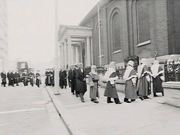
A blanket power to shut protest out of central Sydney after a terrorist attack was not a purpose a parliament was constitutionally free to pursue. That is the holding of the New South Wales Court of Appeal in Jarrett v State of New South Wales [2026] NSWCA 62, delivered on 16 April 2026 by Chief Justice Andrew Bell, President Julie Ward and Justice Stephen Free. The court declared three sets of provisions invalid: Part 2, Division 3A of the Terrorism (Police Powers) Act 2002, section 200(5) of the Law Enforcement (Powers and Responsibilities) Act 2002, and sections 27A and 27B of the Summary Offences Act 1988. The state was ordered to pay the plaintiffs' costs.
The provisions were inserted by the Terrorism and Other Legislation Amendment Act 2025, passed in an emergency sitting on Christmas Eve, days after the attack of 14 December 2025 at Bondi Beach in which 15 people were killed at a Chanukah gathering. Criminal proceedings arising from that attack are still before the courts. The Act created the public assembly restriction declaration, or PARD. Once the Police Commissioner declared an area, no public assembly held wholly or partly inside it could be authorised under Part 4 of the Summary Offences Act, and any authorisation already granted was revoked. A declaration ran for 14 days, could be extended in 14 day blocks and could last 90 days in total. Section 200(5) switched off the statutory shield that ordinarily stops police issuing move on directions to people taking part in a protest.
The first declaration commenced on 24 December 2025 and expired on 17 February 2026, initially covering the Central Metropolitan Police Region and later narrowed to the Sydney central business district and parts of the eastern suburbs, including Parliament House and Queen's Square. The agreed facts record what that meant on the street. On 18 January 2026 a rally at Hyde Park marking a death in custody was met by mounted police who blocked the march route, and the organiser told the crowd to disperse. On 9 February 2026, at a Town Hall protest against a visit by the Israeli President, police used capsicum spray, arrested 27 people, including two of the plaintiffs, and charged nine.
The court never reached the usual balancing exercise, because the purpose itself failed. Discouraging all public assemblies in an area, whatever their subject and whatever their actual effect on community safety, is not compatible with the constitutionally prescribed system of representative and responsible government. The judgment describes peaceful protest as communication indispensable to the exercise of political sovereignty by the people, and says representative democracy involves acceptance of disharmony, incivility and disruption. In the alternative, the means were not reasonably appropriate and adapted: the scheme was, in the court's phrase, a blunt tool which does not require, or even allow for, consideration of the characteristics or conduct of any particular public assembly, or of the nature or severity of any threat.
The declaration had already lapsed nine days before the hearing on 26 February 2026, and the state argued there was nothing left to decide. The court kept the case, finding a real and not remote risk that further declarations would affect the plaintiffs, who between them organise Palestinian solidarity marches, Aboriginal deaths in custody rallies and Jewish anti occupation protests.
This is not the first such loss. In Kvelde v State of New South Wales [2023] NSWSC 1560 the Supreme Court held part of section 214A of the Crimes Act 1900, the 2022 major facilities offence, invalid on the same ground. On 16 October 2025, in Lees v State of New South Wales [2025] NSWSC 1209, Justice Mitchelmore declared section 200(5), as inserted in March 2025 by the Crimes Amendment (Places of Worship) Act 2025, invalid because a narrower rule confined to people entering or leaving a place of worship would have achieved the same protective purpose. A provision bearing that same number was back before the courts, and struck down again, within six months.
The reaction split along predictable lines and the sources do not agree on what the ruling proves. Premier Chris Minns said he was obviously disappointed, adding that the laws came in the aftermath of the worst terrorist attack the country has seen and that the government believed they were necessary and important for Sydney at the time. Amnesty International Australia called the outcome a testament to people power and collective action. The Greens justice spokesperson, Sue Higginson, said civil liability in the tens of millions was now inevitable. Writing in LawNews on 20 April 2026, the New Zealand barrister Warren Pyke read the case as evidence that rights need judicial teeth during a crisis rather than aspirational statements.
Several things remain unknown. Nothing on the public record as at mid August 2026 shows the state seeking special leave to appeal to the High Court. It is unresolved what becomes of the nine people charged at Town Hall on 9 February, of arrests and directions made while invalid provisions were on foot, and whether damages claims will follow. Nor has the government said whether it will attempt a narrower scheme, or a fourth time.
Sources
Every factual claim above rests on the 11 published sources below. They are listed so you can check the reporting rather than take it on trust.
- Supreme Court of New South Wales (Caselaw NSW)Jarrett v State of New South Wales [2026] NSWCA 62
- Wikisource (full text of judgment)Lees v State of New South Wales [2025] NSWSC 1209
- NSW Parliamentary Research ServiceProtest law in New South Wales
- 13 Wentworth ChambersJarrett v State of New South Wales [2026] NSWCA 62 (16 April 2026) (Bell CJ, Ward P and Free JA)
- SBS NewsMinns says NSW government 'disappointed' as protest laws ruled unconstitutional
- National Indigenous TimesNSW anti-protest laws ruled invalid by Court of Appeal
- Amnesty International AustraliaAmnesty Australia welcomes Court ruling striking down anti-protest laws
- Michael West Media"Unconstitutional". Court strikes down Minns' draconian anti-protest laws
- Honi Soit"Draconian" NSW anti-protest laws struck down in historic win for free speech
- LawNews (The Law Association, New Zealand)Why rights matter, especially in a crisis: NSW Court of Appeal rules on post-Bondi restrictions on public assemblies
- NSW CourtsNSW Government's Blanket Ban on Protest Marches is Unconstitutional, Court Finds