Foreign policy
Trump says he will declare the strait of Hormuz US territory, but no legal instrument exists
At a police training centre in Garden City, New York on 14 August 2026 Donald Trump said he would soon declare the Hormuz strait a territory of the United States, citing the naval blockade. Iran rejected it, no order accompanies it, and three ships transited that day against a pre war 130.
Speaking at the David S Mack Center for Training and Intelligence in Garden City, New York on Friday 14 August 2026, Donald Trump said that once the war with Iran is over he intends to claim the Strait of Hormuz for the United States. Al Jazeera quoted him directly: "After we finish defeating Iran, which is being very badly defeated, pretty soon I'll be declaring the Hormuz Strait a territory of the United States." He offered the naval blockade as the justification. "We have the blockade. No ships get through unless we want them to."
No executive order, proclamation, State Department position or other legal instrument accompanying that statement was identified in any of the reports consulted for this article. The announcement exists, so far, as a line in a speech. Al Jazeera quoted Bruce Fein, a former associate deputy attorney general under Ronald Reagan, saying that a treaty ratified by the Senate or a statute is constitutionally required to annex territory. The international law specialist Natalie Klein told the same outlet that American control would in practice require military occupation of Iranian coastal areas, which does not exist.
Iran rejected it within a day. Euronews reported that deputy foreign minister Kazem Gharibabadi wrote that "the Strait of Hormuz has been Iranian, is Iranian, and will remain Iranian", adding that "this strait will only be closed and opened under Iran's command". Al Jazeera carried a further Gharibabadi line that the strait "cannot be seized by tweet, nor by aircraft carrier, nor by issuing an order, nor by an election speech", and reported that the head of Iran's judiciary called the remarks nonsense. Foreign minister Abbas Araghchi said Iran was negotiating with Oman over managing maritime traffic. On 15 August, according to Wikipedia's current events portal citing Iran International and the Saudi Gazette, Iranian foreign ministry spokesperson Esmail Baghaei said Iran and Oman had reached an agreement on a safe route for vessels transiting the strait.
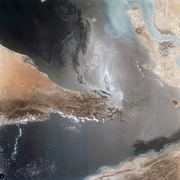
The law of the sea does not obviously accommodate what Trump described. Part III of the United Nations Convention on the Law of the Sea, which can be read on the UN website, sets out a regime of transit passage for straits used for international navigation. Article 34 provides that the regime of passage "shall not in other respects affect the legal status" of the waters or the sovereignty and jurisdiction of the states bordering the strait. Article 38 provides that all ships and aircraft enjoy the right of transit passage, "which shall not be impeded". Article 44 says states bordering straits "shall not hamper transit passage". Al Jazeera notes that territorial seas extend 12 nautical miles, that the strait is about 21 nautical miles wide at its narrowest with overlapping Iranian and Omani waters, and that neither the United States nor Iran has ratified the convention, although its rules on international straits are widely regarded as customary law. The convention constrains Iran from closing the strait and does not create a mechanism by which a third state can own it.
The practical position is that almost nothing is moving. SBS News reported on 15 August that only three vessels transited the strait on the Friday, a grain ship, an empty dry bulk carrier and an empty LPG tanker, against nine on the Thursday, five on the Wednesday and a pre war average of more than 130 a day, with no crude oil shipments visible on the Friday. US defence secretary Pete Hegseth said the blockade could be held "indefinitely, the United States Navy can maintain a blockade like that because we'll rotate ships in and out". Treasury secretary Scott Bessent said Washington would "apply measures like have never been seen in the history of economic isolation on a country".
Accounts of the strait's normal share of global oil differ. Al Jazeera puts it at about one fifth of global oil and gas. Euronews describes it as roughly a quarter of the world's seaborne oil trade. Both are describing the same chokepoint, and neither figure has been updated for a waterway that is currently carrying a fraction of its usual traffic.
The sequence that produced the closure is reported at different levels of detail. Al Jazeera dates the start of the war to 28 February 2026 and describes a memorandum of understanding signed in June that was expiring on 16 August. Euronews says Iran effectively closed the strait after the war began in late February, that a provisional June agreement required Iran to reopen it and to reaffirm that it would not pursue nuclear weapons while the United States lifted its blockade and sanctions, and that Iranian attacks on shipping in July prompted fresh American strikes and a reimposed blockade. SBS reports that the blockade was lifted for one month from mid June before being reimposed. No party has published the text of the June agreement.
Shipping is still being hit. Al Jazeera reported on 14 August that the United Arab Emirates condemned attacks on two vessels linked to the Abu Dhabi National Oil Company on the Thursday evening, calling it a "hostile Iranian attack" and describing the use of the strait as a tool of economic coercion as piracy. Wikipedia's current events portal logs the same accusation under 13 August. Al Jazeera said the attack followed a similar one on an ADNOC tanker the previous Saturday, and that ADNOC counted 15 of its vessels attacked in the strait since February. Iran did not immediately comment. The New Region quoted the Persian Gulf Strait Authority saying the strait "remains blocked and will not be reopened until Iran's conditions are accepted", while Trump described the blockade of Iranian ports as a wall of steel and claimed total control of the waterway.
What remains unknown is whether the annexation line will ever be attached to a document. No US agency has published a legal theory for it, no map or coordinates have been offered, and the White House has not said whether the words were policy.
Sources
Every factual claim above rests on the 8 published sources below. They are listed so you can check the reporting rather than take it on trust.
- Al JazeeraTrump threatens to make the Strait of Hormuz a US territory: can he?
- EuronewsIran says Strait of Hormuz will remain Iranian after Trump warning
- SBS NewsStrait of Hormuz shipping collapses under US blockade of Iran
- United NationsUnited Nations Convention on the Law of the Sea, Part III: straits used for international navigation
- Al JazeeraUAE accuses Iran of attacks on two ADNOC vessels in Strait of Hormuz
- The New RegionStrait of Hormuz remains blocked as UAE condemns attacks on its vessels
- WikipediaPortal: Current events, 15 August 2026
- WikipediaPortal: Current events, 13 August 2026