Church and state
Texas classrooms must post the Ten Commandments after a nine to eight appeals court ruling
The Fifth Circuit split 9 to 8 on 21 April 2026 to uphold Senate Bill 10, which orders a 16 by 20 inch Ten Commandments poster in every Texas public school classroom. The majority says Stone v. Graham (1980) is a dead letter. Eight judges say only the Supreme Court can kill it.
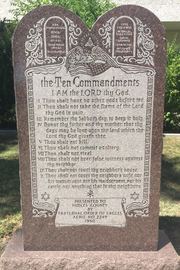
On 21 April 2026 the full United States Court of Appeals for the Fifth Circuit ruled, by nine votes to eight, that Texas may require every public school classroom in the state to display the Ten Commandments. The decision in Nathan v. Alamo Heights Independent School District, No. 25-50695, reversed the district court, vacated the preliminary injunction that had held the law back since August 2025, and dismissed the families' claims outright rather than sending them back for trial.
The law at issue, Senate Bill 10, was passed in June 2025 and sits in the Texas Education Code at section 1.0041. It obliges public elementary and secondary schools to hang, in each classroom and in a conspicuous place, a durable poster or framed copy of the Ten Commandments measuring at least 16 inches wide and 20 inches tall, in a readable typeface. The statute prints the exact wording that must appear and forbids any additional content. Schools must accept privately donated displays that comply, and may buy their own.
Judge Stuart Kyle Duncan wrote for the majority, joined by Chief Judge Elrod and Judges Jones, Smith, Willett, Ho, Engelhardt, Oldham and Wilson. The obstacle was Stone v. Graham, 449 U.S. 39 (1980), in which the Supreme Court struck down a Kentucky statute requiring copies of the Commandments, sixteen inches by twenty, in every classroom. Duncan's answer was that Stone was decided under the Lemon test, and that the Supreme Court discarded Lemon in Kennedy v. Bremerton School District, 597 U.S. 507 (2022). "With Lemon extracted," the opinion says, "there is nothing left of Stone."
In its place the majority asks whether a law resembles a founding era religious establishment. The opinion catalogues what those looked like: compelled attendance at an official church, state control of doctrine and clergy, punishment of dissenters, religious taxes, and churches conscripted for civic functions. Over half the states had establishments when the First Amendment was adopted and the last was dismantled in 1833. Senate Bill 10, the court held, does none of those things. On the claim that the posters coerce children, the majority was blunt: "It puts a poster on a classroom wall."
The families also argued free exercise, leaning on Mahmoud v. Taylor, 606 U.S. 522 (2025). The majority turned that case against them, saying Mahmoud concerned a compulsory curriculum delivered by teachers, whereas Senate Bill 10 authorises no religious instruction and no child is made to recite the Commandments, believe them or affirm their divine origin.
Judge Irma Carrillo Ramirez wrote the principal dissent, joined by Judges Stewart, Richman, Haynes, Graves, Higginson and Douglas. Her position is narrow and hard to dislodge: the Supreme Court has already held that a statute nearly identical to Senate Bill 10 violates the Establishment Clause, and only the Supreme Court may overrule itself. She quotes Stone's finding that posting religious texts on a wall "serves no such educational function" and that private funding of the copies did not save the Kentucky law. The dissent is not unanimous in its own reasoning either: Judge Richman joined only part of it, and Judge Haynes only a part of a part.
The Louisiana comparison matters. A Fifth Circuit panel had struck down that state's Ten Commandments law in Roake v. Brumley, 141 F.4th 614, a ruling the full court vacated. Sitting en banc, the court then dismissed the Louisiana case as unripe, at 170 F.4th 292 (2026), while holding that differences between the two statutes made the Texas case ripe for decision. One circuit, two near identical laws, one answered and one left open.
Attorney General Ken Paxton called the outcome "a major victory for Texas and our moral values". Holly Hollman of the Baptist Joint Committee for Religious Liberty said compelling students to observe a government mandated religious text "undermines the very pluralism that religious freedom depends on". Richard Conn of the Center for Inquiry said the ruling "virtually nullifies the Establishment Clause of the First Amendment". The ACLU of Texas has said the plaintiffs intend to seek Supreme Court review.
A second front has opened in state court. In Roth v. State of Texas, three Houston mothers argue that Senate Bill 10 breaches the Texas Religious Freedom Restoration Act of 1999 and the parental rights amendment approved by Texas voters in November 2025. Texas Values reported that Harris County district judge Bruce Bain refused a temporary restraining order on 7 August 2026. The Texas Tribune's account of the same refusal is filed under 31 July 2026 and records a temporary injunction hearing listed for 17 August. The two dates cannot both be right and neither outlet corrects the other.
For comparison, Victoria's policy on special religious instruction, last updated on 13 February 2026, keeps government schools secular, makes such instruction opt in with parental consent, caps it at 30 minutes a week at lunchtime or before or after school, and bars instructors from trying to convert students. Nothing is fixed to the wall.
What is not yet known is whether the Supreme Court will take the case, and on which question. No docketed petition appears in the reporting reviewed for this article. Nor is it established how many of Texas's classrooms now carry a poster, since compliance depends on donations that districts must accept but nobody is publicly counting.
Sources
Every factual claim above rests on the 10 published sources below. They are listed so you can check the reporting rather than take it on trust.
- United States Court of Appeals for the Fifth CircuitNathan v. Alamo Heights Independent School District, No. 25-50695 (en banc opinion)
- ACLU of TexasLegal Challenges to Texas' Ten Commandments Law, SB 10
- JURISTUS appeals court rules Texas can require Ten Commandments in classrooms
- National Constitution CenterSupreme Court showdown over Ten Commandments likely after federal court decision
- Center for InquiryCFI blasts decision in Texas Ten Commandments case
- Baptist StandardCourt backs Ten Commandments in Texas schools
- The Texas TribuneBid for hold on Ten Commandments posters in Texas schools denied
- CBS News3 mothers sue to block Texas law requiring Ten Commandments in public schools
- Texas ValuesHarris County court rejects attempt to block Texas Ten Commandments law
- Victorian Department of EducationSpecial Religious Instruction: Policy