Physics and cosmology
STAR sees twice the baryons the quark picture predicts, in a paper first posted in August 2024
The STAR collaboration reports in Science on 16 August 2026, DOI 10.1126/science.ads5962, that nuclear collisions produce roughly twice as many baryons as models assuming three valence quarks carry baryon number. The preprint has been public since 27 August 2024, and RHIC stopped running in early 2026.
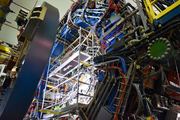
The STAR collaboration at Brookhaven National Laboratory has published a measurement that does not fit the standard classroom account of what makes a proton a proton. The paper, Tracking the baryon number with nuclear collisions, by B. E. Aboona and colleagues, appears in Science volume 393, issue 6812, page 727, DOI 10.1126/science.ads5962. Brookhaven announced it on 13 August 2026 and ScienceDaily carried the release on 16 August 2026 under a headline saying the finding could rewrite textbooks.
The quantity at issue is baryon number, a conserved property that, in the usual telling, is carried one third each by a proton's three valence quarks. Nicole Lewis of Rice University, formerly a Brookhaven postdoctoral researcher, notes in the laboratory's release that the conservation is extremely robust, saying the lifetime of a proton is longer than the lifespan of the universe. The alternative on trial is the baryon junction: a Y shaped knot of gluons where the three colour flux tubes joining the quarks meet, which some theorists have argued is where the baryon number actually sits.
The two pictures make different predictions about what emerges from a collision. Quarks carry electric charge and the junction does not, so the ratio of baryon number to net electric charge in the debris distinguishes them. The junction is also, on this account, harder to drag along. Prithwish Tribedy of Brookhaven puts it as the baryon junction getting held behind while the quarks continue on. STAR measured the ratio of baryon number to the difference in electric charge in isobar collisions, that is collisions of nuclei with the same mass number but different charge, and separately measured net proton yields in photonuclear collisions. Brookhaven reports the team saw about twice as many baryons as models predicted from stopped quarks alone. Zhangbu Xu of Kent State University and Brookhaven summarises the reading as baryon number being more favourably carried and transported by gluons.
The provenance is worth stating precisely, because the coverage reads as news of a new experiment. The STAR preprint, arXiv:2408.15441, was posted on 27 August 2024, almost two years before the journal version. Its abstract is more guarded than the press language: it reports a larger baryon to charge ratio and a less asymmetric net proton yield than the valence quark scenario predicts, says this disfavours that scenario, and points to earlier gold on gold data as consistent. The data are also historical in a second sense. Brookhaven's release states that RHIC operated from 2000 to early 2026, so the machine that produced these collisions has now stopped. The laboratory is building its successor on the same site, the Electron Ion Collider, a joint project with Jefferson Lab that Brookhaven describes as a CT scanner for atoms, colliding electrons with protons and heavier nuclei to image their internal structure.
The caveats are in the laboratory's own account. Brookhaven says the interpretation relies on models inspired by quantum chromodynamics that require additional assumptions, and that the real particle transformations are more dramatic than the simplified description. That is not a small qualification, because the comparison is between data and model expectations rather than between data and a parameter free prediction. A separate paper by Niseem Magdy, Tribedy, Chun Yuen Tsang and Xu, arXiv:2504.09826, submitted on 14 April 2025 and revised on 18 November 2025, makes the point directly: using the PYTHIA 8 framework, the authors find that colour flow and colour reconnection mechanisms materially affect predictions for baryon transport, and argue those effects must be accounted for when comparing models with the STAR measurements.
The junction itself is meanwhile being pinned down from first principles rather than from collisions. Dario Panfalone, Michele Caselle, Nicodemo Magnoli and Lorenzo Verzichelli posted a lattice determination of the baryon junction mass in two space dimensions plus time on 9 March 2026, using high precision three point Polyakov loop simulations in SU(3) Yang Mills theory, work contributed to the 42nd International Symposium on Lattice Field Theory held in Mumbai in November 2025.
What is not established is that the junction picture is correct. STAR's published claim is that the valence quark scenario is disfavoured by these two measurements. Neither Brookhaven's release nor the preprint abstract quotes a statistical significance for the excess, and with RHIC shut down, a repeat with more data at the same machine is no longer available.
Sources
Every factual claim above rests on the 7 published sources below. They are listed so you can check the reporting rather than take it on trust.
- Brookhaven National LaboratoryGluons May Play Central Role in Baryon Number Conservation
- ScienceDailyPhysicists discover a hidden gluon structure inside protons that could rewrite textbooks
- arXivTracking the baryon number with nuclear collisions (STAR Collaboration)
- arXivUnderstanding baryon stopping at the BNL Relativistic Heavy Ion Collider top energies
- arXivLattice Determination of the Baryon Junction Mass in (2+1) Dimensions
- Brookhaven National LaboratoryElectron-Ion Collider
- ScienceDailyPhysics News (section index)
More in Science
AI-designed viruses clear peer review, then an independent check finds them close relatives of the natural original
Arizona physicists shift the quantum noise inside a light pulse, and watch it move in real time
Artemis II flew four people 252,756 miles from Earth in April, but the first landing is now Artemis IV in 2028