US politics
DNC's 2028 calendar opens in South Carolina and puts New Hampshire third, with $18.5 million of debt
The Democratic National Committee voted in Austin on 15 August 2026 for a 2028 early window running South Carolina, Nevada, New Hampshire, New Mexico, Michigan and Virginia. Federal filings to 30 June 2026 show the DNC with $16.3 million in cash and $18.5 million in debt, against $128.5 million at the RNC.
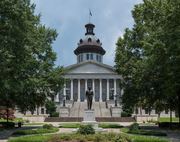
The Democratic National Committee approved its 2028 presidential nominating calendar at its summer meeting in Austin, Texas, on 15 August 2026. The party's own announcement sets out the early window in full: South Carolina on 22 January 2028, Nevada on 1 February, New Hampshire on 8 February, New Mexico on 15 February, Michigan on 22 February and Virginia on 29 February.
That is a durable break with a century of practice. Iowa is gone from the early window entirely, and New Hampshire, which has treated its position as first in the nation as a matter of state law rather than party permission, is placed third behind two states it has never followed.
The party is not shy about why. In its release the DNC chair, Ken Martin, said the committee had delivered a 2028 nominating calendar that truly represents the party and its values and will help it retake the White House in 2028. In a companion release the same day, Martin called the calendar a statement about the kind of Democratic Party we want to be. The DNC's own case rests on three arguments: that Nevada and Michigan are key battleground states, that the six states together contain 4.6 million Black Americans, 4.2 million Latinos, 1.4 million Asian Americans, Native Hawaiians and Pacific Islanders and 370,000 Native Americans, along with 14 million people without college degrees and 1.1 million union members, and that the media markets are cheap enough to keep the window open and affordable for candidates. The same release quotes an Associated Press finding that five of the six are competitive general election states carrying 43 electoral college votes. Those are the party's characterisations of its own decision.
The objections are on the record too. In an Associated Press report carried by ABC News, the Iowa Democratic Party chair, Rita Hart, said the party was out of touch with voters. New Hampshire Public Radio reported that Granite State leaders have vowed to hold the leadoff primary in 2028 regardless, and the AP report noted the state law that requires New Hampshire's secretary of state to schedule the primary at least seven days before any similar contest, and named Senators Jeanne Shaheen and Maggie Hassan among those who called the decision wrong for their state and the country. The DNC calendar and the New Hampshire statute cannot both be satisfied. Nobody has yet said what happens when they collide, and the party has not published what penalty, if any, a state that jumps the queue would face.
The second half of this story is the money, and the numbers that settle it are in the filings rather than in month by month fundraising comparisons. The Federal Election Commission's own summaries cover the cycle running 1 January 2025 to 30 June 2026.
The DNC reported total receipts of $207,439,163.57 and total disbursements of $213,228,720.57. It began the period with $22,122,489.78 in cash and ended 30 June 2026 with $16,332,932.78. It reported debts owed by the committee of $18,510,798.98. Its receipts include $15 million in loans.
The RNC, over the same period, reported total receipts of $278,554,384.48 and total disbursements of $188,080,652.36. It began with $38,065,147.99 in cash and ended with $128,538,880.11. It reported no debts owed by the committee and none owed to it.
So the party has spent more than it raised across the cycle, owes more than it holds, and carries roughly one eighth of its opponent's cash reserve, while committing itself to organise a six state early window in a compressed six week block. The AP report, using the same filings, put the DNC at about $16 million in cash against more than $18 million in debt and the Republicans at $129 million, and reported that critics have questioned Martin's leadership decisions and the party's fundraising, though it also reported that Martin is not expected to be replaced before the midterms because the party has no clear alternative.
What the filings do not tell you is whether the gap matters by 2028. Party committee cash is only one channel: candidate committees, state parties and outside groups all raise separately, and a nominating calendar is largely paid for by campaigns rather than by the national committee. The unresolved questions are narrower and harder. The DNC has not said how it will enforce the order against New Hampshire's statute, what it will do if a state moves, or how it intends to close a debt position that its own filings show while the calendar it just adopted expands the number of states it must service early.
Sources
Every factual claim above rests on the 6 published sources below. They are listed so you can check the reporting rather than take it on trust.
- Democratic National CommitteeDNC votes to officially select early states for 2028 Democratic presidential nominating calendar
- Democratic National CommitteeICYMI: DNC chair, elected officials and advocates highlight proposed 2028 nominating calendar's strengths
- Federal Election CommissionDNC Services Corp / Democratic National Committee, committee financial summary, C00010603
- Federal Election CommissionRepublican National Committee, committee financial summary, C00003418
- ABC NewsDemocrats gathering to give final approval to 2028 presidential primary calendar
- New Hampshire Public RadioDemocrats approve 2028 presidential calendar that puts South Carolina in lead spot