Technology
MIT's AI supercomputer has fallen 36 places in the world rankings without getting any slower
TX-GAIN's measured performance is exactly what it was when MIT unveiled the machine in October 2025. Its position on the TOP500 list has gone from 114th to 150th, which is a measure of how fast everyone else has been building.
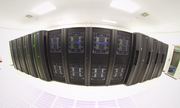
TX-GAIN, the AI supercomputer owned and run by MIT's Lincoln Laboratory, sits 150th on the June 2026 TOP500 list of the world's fastest computers, with a measured High Performance Linpack result of 13.39 petaflops. That is the same measured result the machine recorded on the list current when MIT announced it in October 2025, when it placed 114th.
The TOP500 register lists TX-GAIN as an HP DL385 cluster running AMD EPYC 9254 processors and NVIDIA H100 GPUs over 100 gigabit Ethernet, against a theoretical peak of 41.82 petaflops. MIT News announced the system on 2 October 2025, describing it as the most powerful AI supercomputer at any university in the United States. Lincoln Laboratory had published its own announcement on 23 September and said the system had been running since that summer.
MIT says TX-GAIN uses more than 600 NVIDIA GPU accelerators and reaches a peak of two AI exaflops. It sits in the Lincoln Laboratory Supercomputing Center's facility at Holyoke, Massachusetts. Jeremy Kepner, the Lincoln Laboratory Fellow who heads the centre, said in the announcement that the system would "play a large role in supporting generative AI, physical simulation, and data analysis across all research areas".
Those two performance figures measure different things. The 13.39 petaflops is a measured result on a standard 64-bit benchmark that every system on the TOP500 has to run. The two AI exaflops is a peak figure for AI arithmetic at lower precision, and it is MIT's own. Data Center Dynamics, reporting the launch, noted the distinction explicitly, describing the exaflops figure as a university claim rather than a ranked result.
The wider picture from the June 2026 list, published on 23 June at the ISC conference in Hamburg, explains the drift. LineShine, a system at the National Supercomputing Centre in Shenzhen, entered at number one with a sustained 2.198 exaflops, displacing El Capitan at Lawrence Livermore, which fell to second on 1.809 exaflops. Five systems now exceed one exaflop, up from four. TX-GAIN's measured result is roughly six-tenths of one per cent of the new leader's.
University computing is moving too, mostly outside the United States. On 22 June 2026 NVIDIA announced 35 new AI supercomputers across Europe. One of them, the Mimer AI Factory hosted at Linköping University in Sweden and owned by the EuroHPC Joint Undertaking, is to be built from 100 NVIDIA GB200 NVL4 systems totalling 400 GPUs, and is quoted at up to four exaflops of AI training performance and about seven exaflops of inference. On MIT's own preferred measure that is twice TX-GAIN. Sweden's national infrastructure body NAISS said in April 2026 that Bull had been selected to deliver the system, for installation later this year.
Inside the United States, nothing published contradicts MIT's claim. The largest new university system found in public reporting is at the University of Utah, a fifty million dollar machine with 264 NVIDIA H200 GPUs due online in mid-2026, which is considerably smaller. But the claim rests on MIT's own comparison rather than an independent audit, and universities are not obliged to disclose what they run.
What the machine is for has not changed. MIT News listed protein interaction modelling for biodefence, radar signature evaluation, filling gaps in weather data, finding anomalies in network traffic, and exploring chemical interactions to design medicines and materials. Lincoln Laboratory has said TX-GAIN lets it model both more protein interactions and larger proteins than before. The campus collaborations named at launch were the Haystack Observatory, the Center for Quantum Engineering, Beaver Works and the Department of the Air Force and MIT AI Accelerator.
MIT's announcement also says software written at the Lincoln Laboratory Supercomputing Center can cut the energy used to train AI models by as much as 80 per cent. That figure is MIT's own, and no independent verification of it was found.
The next checkpoint is the November 2026 TOP500 list. MIT has announced no expansion or upgrade to TX-GAIN since launch and has not submitted a new benchmark result. On the pattern of the past twelve months the machine will keep sliding down the table while doing exactly the same work at exactly the same speed. That is the ordinary condition of research computing during a hardware buildout, and not a criticism of the system.
Sources
Every factual claim above rests on the 8 published sources below. They are listed so you can check the reporting rather than take it on trust.
- MIT NewsLincoln Lab unveils the most powerful AI supercomputer at any US university
- MIT Lincoln LaboratoryLincoln Laboratory unveils the most powerful AI supercomputer at a U.S. university
- TOP500MIT Lincoln Laboratory Supercomputing Center: system listing and rankings
- TOP500LineShine Debuts at No. 1 as the TOP500 Enters a New Global Exascale Era
- NVIDIAEurope Unveils a Record 35 New NVIDIA AI Supercomputers
- NAISSBull to deliver AI-optimised supercomputer for Mimer AI Factory
- Data Center DynamicsMIT Lincoln Laboratory deploys Nvidia-powered AI supercomputer
- Silicon SlopesUniversity of Utah unveils $50M AI supercomputer with 264 NVIDIA H200 GPUs